

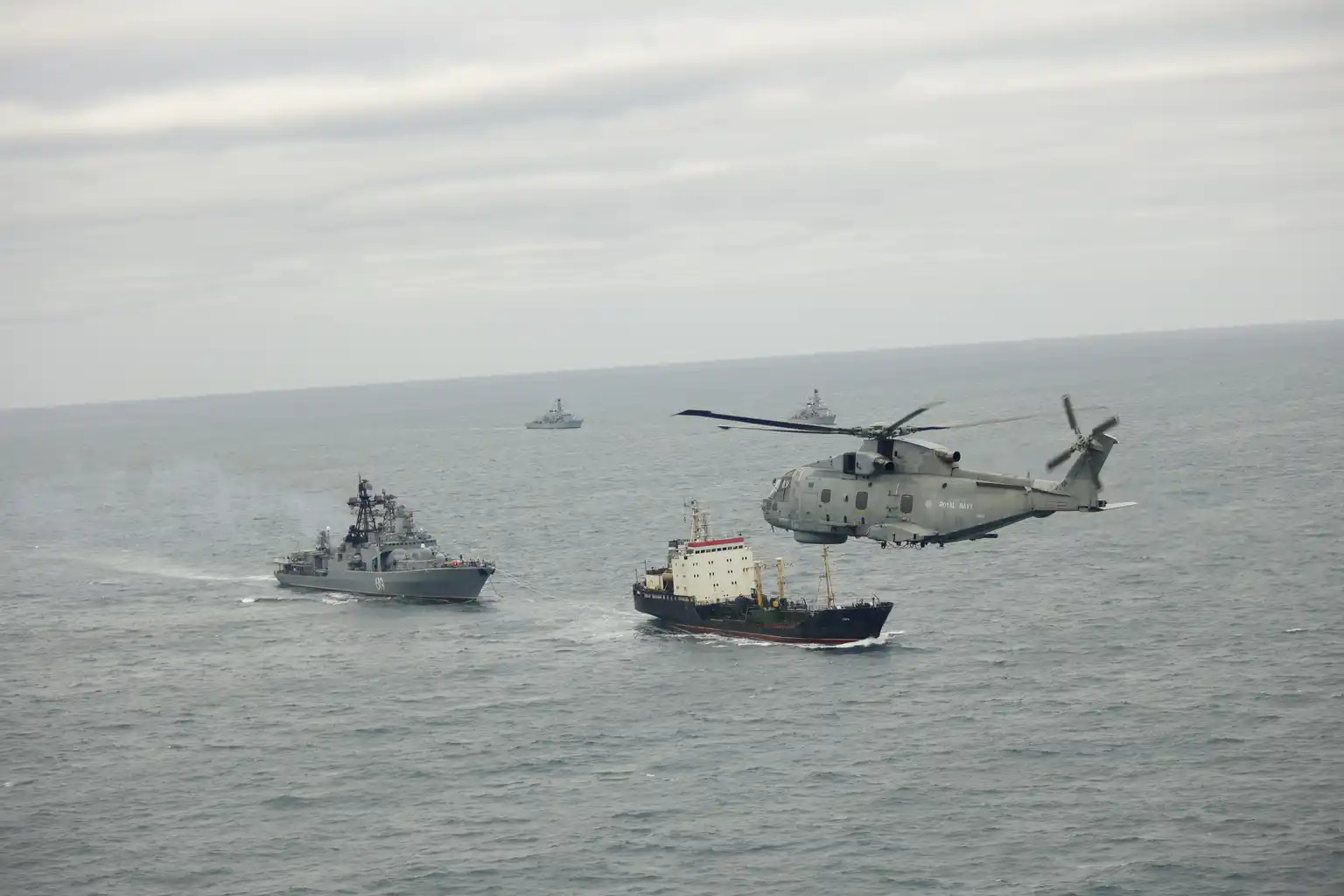
Photo credit: Royal Navy
The Royal Navy has completed ten days of focused operations closely monitoring Russian warships and a submarine in UK waters as part of coordinated NATO efforts.
Naval helicopters and ships HMS Somerset, HMS St Albans, HMS Mersey and RFA Tideforce were dispatched to shadow four Russian Navy vessels, including a surfaced submarine, in the English Channel and North Sea.
Portsmouth-based HMS Mersey were activated three times between March 29 and April 7, working with a Wildcat helicopter from 815 Naval Air Squadron and tanker Tideforce, to report on the movements of Russian frigate Admiral Grigorovich, Ropucha-class landing ship Aleksandr Shabalin and Kilo-class submarine Krasnodar.
Separately, Type 23 frigate HMS Somerset intercepted Russian Udaloy-class destroyer Severomorsk and accompanying oiler Kama, near the coast of Brittany, France, and kept close watch using her powerful array of radars and sensors through the Channel and into the North Sea.
Sister ship HMS St Albans briefly joined Somerset as part of a formal handover as the latter begins four months of operations in the North Atlantic to monitor submarine movements and protect critical undersea infrastructure.
Executive Officer of HMS Mersey, Lieutenant George Hage, said “Mersey routinely acts as one of the high readiness units to protect UK waters, alongside her sister ships HMS Tyne and Severn.
“Our ability to provide a presence to monitor the Russian activity in UK water is no small feat especially with such an increase in activity over the last few months.
“I am extremely proud of Mersey’s ship’s company for their continued dedication and hard work in delivering Mersey to the frontline for these operations.
“We are very proud to be part of the Royal Navy’s commitment to the maritime security of the United Kingdom. Working with our NATO allies continues to highlight the teamwork and strength behind the NATO alliance.”
HMS Mersey was first activated to track the Aleksandr Shabalin on the morning of March 29, near the island of Ushant off the northwest coast of France, reporting on their movements with a Wildcat helicopter as the Russians sailed east through the Channel and into North Sea until March 31.
Then, as the Admiral Grigorovich sailed towards the Strait of Dover, Mersey was ready to intercept – monitoring from April 2 as the frigate sailed west, battling high winds and sea from Storm Dave, to meet Kilo-class submarine Krasnodar and accompanying tug Altay near Ushant.
Mersey and RFA Tideforce then worked together with Belgian, French and Dutch aircraft and ships, to monitor the Russian trio as they together made their eastbound voyage through the Channel.
Meanwhile, during a two-day mission from March 31, Somerset and a Merlin helicopter from 814 Naval Air Squadron monitored Severomorsk.
HMS St Albans met Somerset to formally handover duties of Operation Ceto, the UK’s standing operations to protect Britain’s strategic deterrence and monitoring potential submarine activity in the North Atlantic.
HMS Somerset’s Commanding Officer, Commander Matt Millyard, said: “Since returning from operations in December 2025, an incredible amount of work has gone into preparing HMS Somerset to reassume the Op Ceto duty again and I am very proud of the crew for achieving so much in such little time.
“The months ahead promise to be a complex mix of tasking for the ship but we are ready and look forward to the challenge.”